



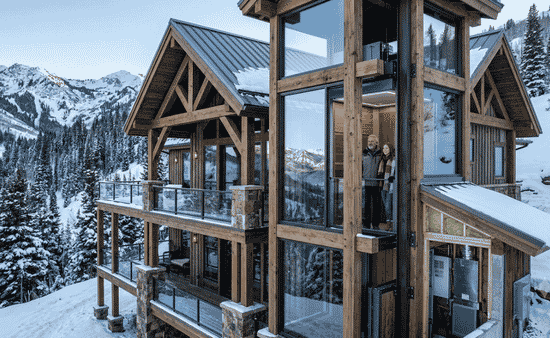
Most residential lift specifications are written around sea-level conditions and moderate temperature ranges. For homeowners in mountain communities, that gap between standard specs and actual operating conditions is worth understanding before a system is selected.
The good news is that well-designed residential lift systems can handle high-altitude and extreme-temperature environments reliably, but the specifics of how they do it matter, and not every system handles these conditions with equal effectiveness.
Why Altitude Creates Real Engineering Considerations
Air density decreases with elevation. At 7,000 feet, for example, the air is meaningfully less dense than at sea level, and that difference has practical implications for systems that depend on air as part of their operation.
Pneumatic Vacuum Lifts at Altitude
The clearest example is a pneumatic vacuum lift, which uses pressure differentials created by moving air above and below the cab to drive the system up and down. These systems are well-suited to many residential applications, but at significant elevation, the reduced air density changes how the pressure differential behaves.
Manufacturers of pneumatic systems account for this with altitude ratings and may require adjustment or configuration changes for installations at elevation. It’s a solvable engineering consideration, but it’s one that needs to be addressed explicitly rather than assumed to be covered under standard specs.
Motor and Electrical Components
Electric motors and associated control systems also operate differently at high altitude. Reduced air density means less effective cooling for motor windings and electrical components that generate heat during operation.
Systems designed with adequate thermal margin for the actual elevation of the installation will perform more reliably over time than those sized for sea-level conditions and pushed harder than intended because the cooling isn’t performing as designed. This is the kind of specification detail that’s invisible when a system is new and running in mild weather, but that shows up in performance and longevity over time.
How Temperature Extremes Affect Performance and Components
Mountain properties experience temperature swings that go well beyond what most residential systems are routinely tested against. A property at 7,500 feet can see outdoor temperatures well below zero in winter and significant heat in summer, particularly in sun-exposed locations.
Hydraulic System Fluid Behavior
For electro-hydraulic systems, temperature has a direct effect on fluid viscosity. Cold fluid is thicker and moves more slowly through the system, which can affect the smoothness and speed of operation during startup in very cold conditions.
Quality hydraulic systems use fluids formulated for temperature stability across a broader range, and some installations in cold climates include heating elements in the mechanical space to keep fluid temperatures within optimal range.
Seals and Material Behavior
Seals, gaskets, and the materials used in guides and rollers all behave differently across wide temperature ranges. Materials that are flexible and effective at moderate temperatures can become brittle and less effective in extreme cold, and can expand beyond their intended tolerances in summer heat. Systems specified for mountain installations should use components rated for the actual temperature range of the location.
The Structural Context of Mountain Homes
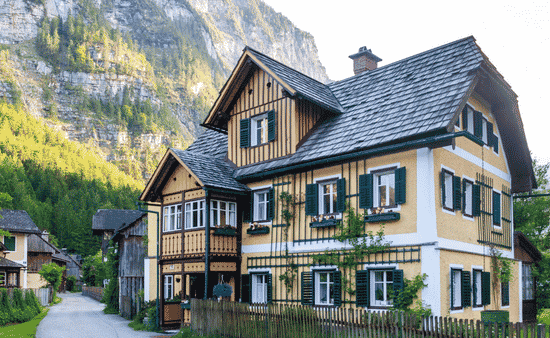
Beyond the lift system itself, mountain homes often present structural characteristics that differ from typical residential construction. Steeper rooflines, post-and-beam construction, larger open floor plans, and greater travel heights between floors are all common in mountain architecture.
Including these features in your essential annual house maintenance schedule helps ensure that lift systems, structural elements, roofing, and other key components remain safe and perform reliably throughout the year.
Taller Travel Heights
A property that spans a hillside or has multiple levels designed to follow the terrain may have greater vertical travel than a typical two-story suburban home. This affects cab speed, counterweight sizing for cable systems, and the overall shaft or cylinder dimensions required.
Understanding the full travel distance from the lowest served floor to the highest is an important early step in matching the right system to the property. A system rated for a standard two-story residential application may not be the right choice for a property where the effective travel distance is considerably greater, and selecting the right capacity from the start avoids retrofitting or early replacement.
Non-Standard Construction Methods
Post-and-beam and heavy timber construction common in mountain homes can require different approaches to shaft framing and load transfer than standard stud-frame construction. The structural integration of a lift shaft into a timber frame is solvable, but it benefits from an installer familiar with both lift installation and mountain home construction practices.
Getting the Right Specification From the Start
The combination of altitude, temperature range, and structural characteristics in mountain properties makes the site assessment conversation particularly important for installations in these locations. A standard residential lift quote built around typical conditions may not account for the modifications needed to perform reliably at 7,500 feet through a full range of mountain seasons.
For homeowners exploring small home elevators in Park City, UT, or similar high-altitude mountain communities, asking specifically about altitude and temperature ratings during the consultation establishes early whether a given system has been specified for the actual conditions or simply selected from a standard catalog.
An installer with experience in mountain property installations will raise these considerations without being prompted, which is itself a useful signal about how thoroughly the installation will be handled.
Conclusion
High altitude, extreme temperatures, and mountain construction add real but manageable complexity to a residential lift installation. Understanding where those complexities show up, and confirming that the system being specified accounts for them, is what separates a lift that performs reliably through winter and summer for decades from one that develops problems that could have been avoided with a more complete specification from the start.